Studio Monitors for Nearfield and Midfield Reference Monitoring
A studio monitor is a reference speaker built to reproduce audio as accurately as possible, without the bass enhancement or high-frequency boosting that consumer speakers add to make music sound immediately pleasing. The purpose of a studio monitor is to expose problems in a mix, not hide them. The monitors in this collection cover nearfield and midfield applications across 2-way, 3-way, and 4-way designs. Matching driver size and architecture to your room size and listening distance is the most important decision before purchasing a studio monitor.
Nearfield Studio Monitors — Accurate Reference at Close Listening Distances
Nearfield monitors are designed for listening distances of 1 to 1.5 meters from the listening position. At that distance, the direct sound from the monitor reaches your ears before room reflections do, reducing the influence of your room's acoustic problems on what you hear. Nearfield monitors are the correct choice for home studios, project studios, and any room without significant acoustic treatment.
The EVE Audio SC208 is a 2-way nearfield monitor with an 8-inch woofer extending low-frequency response below 45 Hz. It covers mix rooms requiring accurate bass reproduction at nearfield distances without stepping into midfield monitor territory. The EVE Audio SC2070 is a 2-way nearfield monitor with a 7-inch woofer suited to smaller control rooms and project studios working at close listening distances. Both monitors use EVE Audio's AMT tweeter technology, extending high-frequency response beyond 40 kHz with total harmonic distortion below 0.1% at typical monitoring levels.
EVE Audio SC4070 — 4-Way Active Monitor for Mid to Large Control Rooms
The EVE Audio SC4070 is a true 4-way active studio monitor delivering 1,000W of total amplification across dedicated amplifiers for each driver. Dual 6.5-inch SilverCone woofers work together up to 280 Hz, extending bass response down to 32 Hz while keeping distortion controlled at higher output levels. A 4-inch mid driver covers the critical midrange band between 280 Hz and 3,000 Hz. The AMT RS3.1 tweeter handles everything above 3,000 Hz with response extending to 25 kHz.
Four-way architecture dedicates a separate driver to each frequency band rather than asking a single woofer to cover both bass and midrange simultaneously. This produces cleaner midrange reproduction at higher SPL levels, which is why multi-way designs are standard in professional mix rooms and mastering suites handling critical decisions across the full frequency spectrum.
The SC4070 includes a rotatable center plate allowing vertical or horizontal placement without compromising driver alignment or stereo imaging. EVE Audio's SMART-knob DSP provides quick access to high-shelf, mid EQ, desk filter, and low-shelf adjustments with lockable settings for consistent session-to-session calibration. Maximum SPL reaches 116 dB per pair, covering large control rooms and high-volume mixing applications. The SC4070 is the correct choice for engineers building a permanent mid to large format monitoring system requiring flat, full-range reference reproduction down to 32 Hz.
EVE Audio SC305 — 3-Way Midfield Monitor for Treated Mix Rooms
The EVE Audio SC305 is a 3-way midfield studio monitor with a 5-inch woofer in a three-way configuration. Three-way architecture dedicates a separate driver to the midrange frequencies, producing cleaner midrange reproduction at higher SPL levels than a 2-way design at equivalent listening distances. The SC305 is suited to acoustically treated mix rooms working at listening distances of 1.5 to 3 meters where midrange clarity and low-frequency extension beyond the nearfield range are both priorities.
Antelope Audio Atlas i8 — Integrated Monitoring with Onboard Conversion
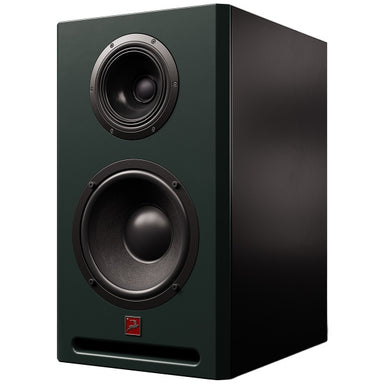
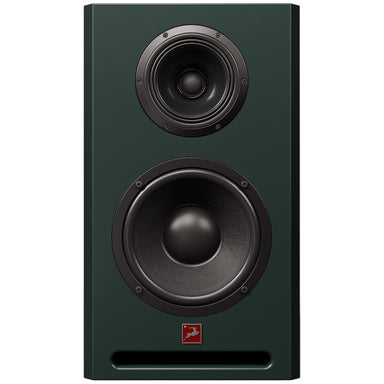
The Antelope Audio Atlas i8 combines studio monitor functionality with onboard AD/DA conversion, offering an integrated monitoring solution for engineers who want reference-quality playback without a separate audio interface in the signal chain. The Atlas i8 is suited to studios where monitoring and conversion in a single unit simplifies the signal path and reduces the number of components in the rack.
AMT Tweeters — Why EVE Audio Monitors Measure Differently Above 10 kHz
Every EVE Audio monitor in this collection uses an AMT (Air Motion Transformer) tweeter. Standard dome tweeters move a dome forward and backward to displace air. As frequency increases above 15 kHz, dome mass limits accuracy, introducing distortion at the upper edge of the audible range. AMT tweeters move air by squeezing and expanding a pleated diaphragm, generating more air movement per unit of diaphragm displacement than a dome. The result is a tweeter extending beyond 40 kHz with total harmonic distortion below 0.1% at typical monitoring levels. For mixing decisions involving high-frequency EQ, reverb tails, and stereo imaging, the additional resolution AMT tweeters provide in the 10 to 20 kHz range is audible and directly useful.
DSP Calibration — Compensating for Room Placement Without External Hardware
Every EVE Audio monitor includes onboard DSP calibration controls for compensating the acoustic effects of specific room placements. The low-shelf control adjusts for boundary reinforcement — the bass buildup that occurs when monitors sit near walls or on a desk surface. A mid-dip control addresses buildup common in small rooms between 100 Hz and 200 Hz. A high-shelf control adjusts tweeter output to account for room absorption at high frequencies. Setting these correctly requires either measurement software like Room EQ Wizard with a calibrated microphone, or an acoustic consultant.
Browse related categories: Audio interfaces for sale | AD/DA converters | Subwoofers and PA systems



 Save $361.00