Master Clocks for Professional Digital Audio Synchronization
A master clock provides a single timing reference that all digital devices in a studio lock to simultaneously. Every digital audio device generates its own internal clock, a timing signal that determines when analog-to-digital conversion samples occur. When multiple devices run on separate internal clocks, phase coherence between them degrades. A dedicated master clock eliminates that degradation by replacing every device's internal reference with a single, ultra-stable external source. The master clocks in this collection cover three tiers of oscillator technology: oven-controlled crystal, and two levels of rubidium atomic precision.
When You Actually Need a Dedicated Master Clock
A single audio interface operating on its own internal clock performs at a level that is practically indistinguishable from an external clock for most recording applications. A master clock is not a universal upgrade. It is a solution to specific problems.
The case becomes clear in three situations. First, when two or more converters or interfaces must operate simultaneously in the same session. Phase coherence between devices locked to a shared external master is measurably tighter than two devices daisy-chained via word clock. Second, when the studio handles mastering, audio post-production, or high-resolution archival recording where cumulative jitter across multiple conversion stages is relevant. Third, when building permanent infrastructure supporting multiple engineers or rooms, where a central master clock simplifies every future device addition.
Antelope Audio OCX-HD — Oven-Controlled Crystal Oscillator with 10 Word Clock Outputs
The Antelope Audio OCX-HD is built around a 4th-generation Acoustically Focused Clocking engine with a 64-bit Direct Digital Synthesis system and an oven-controlled crystal oscillator stable to less than 0.02 ppm at operating temperature. Oven-controlled crystal oscillators maintain a constant internal temperature to eliminate the frequency drift that affects standard crystal oscillators as ambient temperature changes.
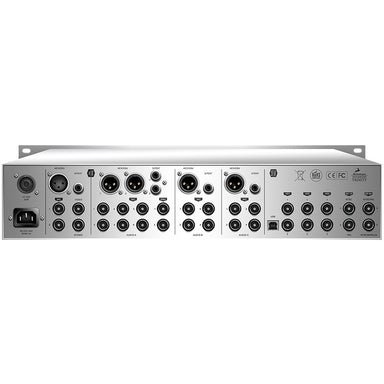
The OCX-HD provides 10 word clock outputs via BNC, 4 AES/EBU outputs via XLR, and 2 S/PDIF outputs via RCA simultaneously. It accepts word clock, video sync, S/PDIF, AES/EBU, and a dedicated 10 MHz atomic clock input. That 10 MHz input allows the OCX-HD to lock to the Antelope 10MX rubidium atomic oscillator for reference-grade timing performance. Sample rate support extends from 32 kHz to 768 kHz across all outputs simultaneously.
The OCX-HD is the correct choice for studios requiring a high-output word clock distribution hub with video sync capability for audio-for-picture workflows, and for facilities wanting oven-controlled crystal precision with the option to upgrade to atomic reference via the 10 MHz input.
Antelope Audio 10MX — Rubidium Atomic Oscillator at 0.05 Parts Per Billion
The Antelope Audio 10MX is built around a rubidium ultra-stable resonance-controlled master oscillator delivering 0.05 parts per billion precision. That is three orders of magnitude more stable than a professional interface's internal clock. Antelope's 4th-generation 64-bit AFC processes the raw rubidium oscillator output before distribution, removing residual irregularities before the clock signal reaches connected devices.
The 10MX provides 4 word clock outputs via BNC, 2 AES/EBU outputs via XLR, 2 S/PDIF outputs via RCA, and 10 dedicated 10 MHz atomic clock outputs via BNC for distributing the raw atomic reference to compatible devices including the OCX-HD. Phase noise measures -130 dBc/Hz at 1 kHz. Short-term stability measures 3E-11 at one second. Sample rate support extends to 768 kHz.
The 10MX is the correct choice for mastering facilities, high-resolution archival studios, and any installation where atomic-grade timing precision is the priority and the rubidium oscillator's stability margin over oven-controlled crystal technology is audibly or measurably relevant to the work being done.
Antelope Audio Trinity — Rubidium Atomic Oscillator with 8 Independent Buffered Outputs
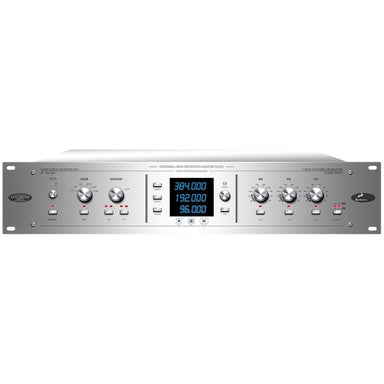
The Antelope Audio Isochrone Trinity combines a rubidium atomic oscillator with Antelope's 64-bit AFC platform and 8 independently buffered word clock outputs. Independent buffering on each output ensures that the impedance load of one connected device does not degrade the clock signal quality received by other devices on separate outputs. In configurations distributing word clock to 4 or more devices, this distinction is significant. Without independent buffering, impedance loading compromises clock signal quality at the far ends of the distribution chain.
Word clock output formats include BNC at standard and double-speed word clock, plus AES/EBU, MADI, and network audio synchronization signals simultaneously. The Trinity can serve as the master reference for every digital device in a studio regardless of connection format. At 50 femtoseconds of jitter, the timing error introduced by the Trinity's clock is inaudible by any published measurement standard.
Jitter — The Problem a Master Clock Solves
Jitter is timing variation in the clock signal around the ideal sample interval. Every digital clock generates some amount of it. Consumer audio interfaces measure jitter at 100 to 500 picoseconds. Professional interfaces with good internal clocking measure below 1 nanosecond. The Antelope Trinity's rubidium oscillator measures below 50 femtoseconds, which is 1,000 times more stable than a professional interface's internal clock. Engineers typically describe uncorrected jitter as a lack of focus in the stereo image, high-frequency smearing, or listening fatigue that arrives faster than it should. A master clock at this precision level removes that variable from the system entirely.
Browse related categories: AD/DA converters | Antelope Audio interfaces | Audio interfaces for sale